Regulatory information checked on 25 November 2026.
Six months after leaving, a former employee still has an active remote access account. No one is officially using it, and no one knows who is responsible for closing it. This fictional case illustrates a common weakness: access rights can outlast the business need that justified them.
Access management is one practical area for SMEs to address under NIS 2. The NIS 2 Directive and DORA, which applies to the financial sector, raise expectations and have implications for some IT providers. Your immediate priorities are to identify accounts, limit permissions and document your decisions.
This guide helps you assess which rules apply and organise your first identity and access management tasks. It focuses on access, which is one part of compliance. It does not constitute legal advice.
The free NIS 2 and DORA checklist covers 25 access controls you can review in your SME.
NIS 2 covers a broad range of sectors essential to the economy. DORA governs digital resilience in the financial sector. Its sector specific rules take precedence over equivalent NIS 2 provisions.
The EU directive covers 18 sectors, including healthcare, transport and certain digital services. It distinguishes between essential and important entities. Management bodies must approve risk management measures and oversee their implementation, making cybersecurity a governance responsibility.
The Digital Operational Resilience Act (DORA) has applied since 17 January 2025. It covers the categories of financial entities defined in the regulation, with some exclusions and proportionate arrangements. Articles 28 to 30 also govern the use of information and communication technology (ICT) service providers.
An EU directive must be transposed into national law. An EU regulation applies directly. France’s NIS 2 legislative timetable is therefore distinct from the DORA obligations already in force.
For NIS 2, start with your sector and company size. For DORA, check your status in the financial sector and then review your contracts with affected customers.
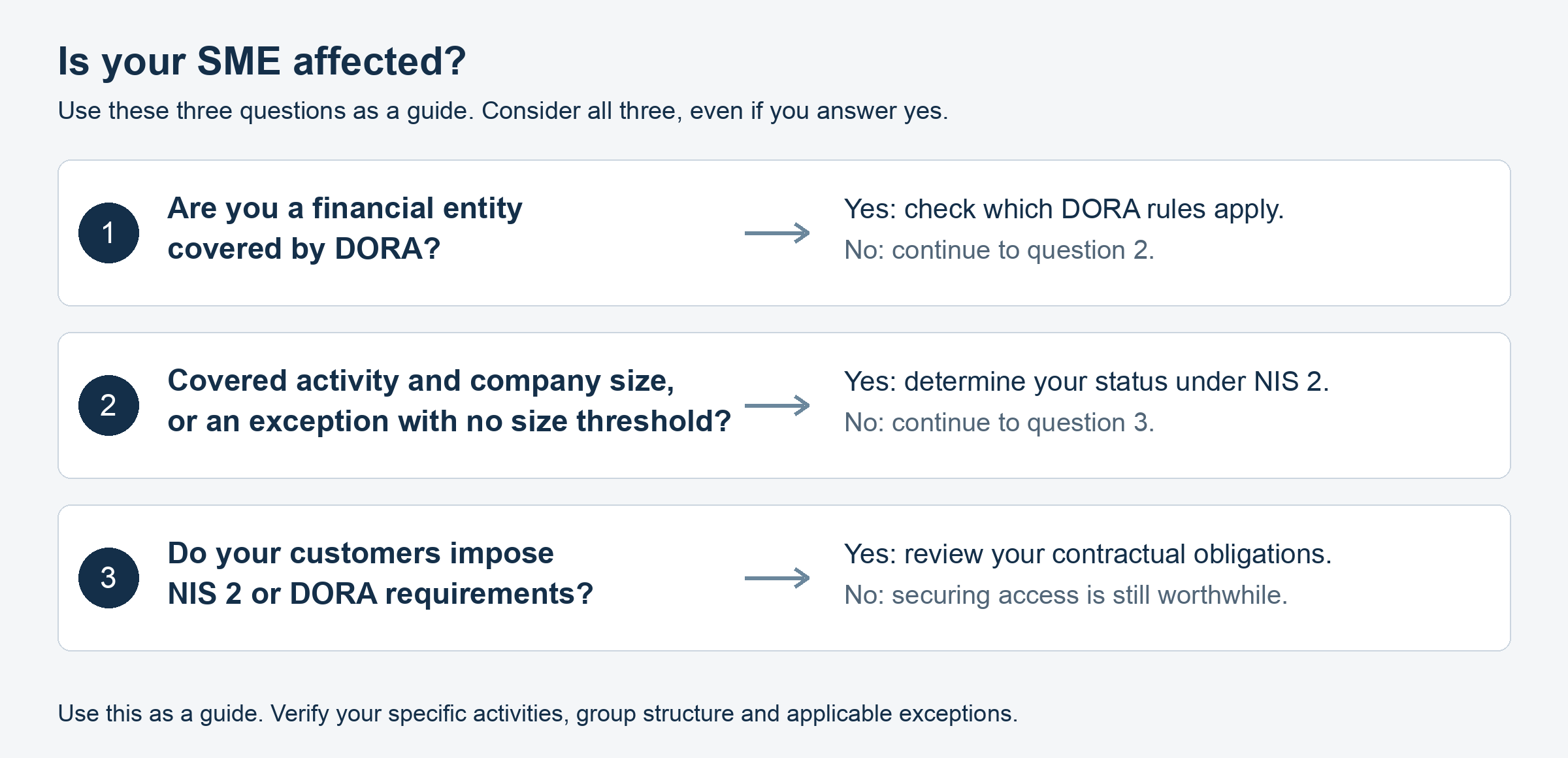
A first indication is whether your business carries out a covered activity and has at least 50 employees, or exceeds €10 million in both annual turnover and balance sheet total. This is a starting point. Figures from partner or linked enterprises can affect the calculation, and some activities are covered regardless of size.
The essential entity designation depends on sector and specific circumstances as well as company size. Use the simulator from ANSSI, France’s national cybersecurity agency, via its official NIS 2 and MonEspaceNIS2 page (in French). Keep a record of your assumptions.
A financial SME can be directly in scope. A managed IT services firm working for a bank is more likely to face contractual requirements covering security, cooperation, evidence and, depending on the services, audits. The relationship does not automatically transfer all of the bank’s obligations to the firm. ICT providers designated as critical are subject to a separate EU oversight framework.
Customers covered by these rules must manage supply chain risk. They may ask you to use individually assigned accounts, implement stronger authentication or provide evidence that access was revoked. Identify the exact services and environments involved before committing.
As of 25 November 2026, adoption at first reading did not mean the bill had been enacted. EU penalty provisions and national rules that have actually entered into force are distinct.
The French Senate adopted the resilience bill on 12 March 2025. The National Assembly amended and adopted it on 17 November 2026. The official legislative record (in French) then lists the joint committee stage. Check the current legislative status and any implementing measures.
For breaches of Articles 21 or 23, Article 34 of NIS 2 requires Member States to set maximum fines of at least €10 million or 2% of total worldwide annual turnover for essential entities, and €7 million or 1.4% for important entities. The higher figure applies. The turnover figure is taken from the preceding financial year of the undertaking to which the entity belongs. These figures describe minimum levels for statutory caps. Individual fines are neither automatic nor subject to these figures as minimum amounts.
You can already deal with overlooked accounts and document your decisions. ANSSI encourages early preparation. The timetable for any future French obligations is a separate question.

Both frameworks call for access controls proportionate to risk. DORA sets out more detailed procedures, while Article 21 of NIS 2 lays down general requirements.
Article 21 of the NIS 2 Directive covers access control policies, human resources security and asset management. It calls for multi-factor authentication (MFA) or continuous authentication where appropriate. MFA combines distinct factors, such as a password and a security key.
Article 9 covers access protection. The regulatory technical standards (RTS) in Articles 12, 20 and 21 of Delegated Regulation 2024/1774 detail logging, identities and access rights. The table summarises the general DORA framework. A simplified framework applies to some entities.
For service providers, apply these requirements within the scope agreed with the customer. Account exports, dated approvals and remediation tickets are useful evidence to prepare. An access governance process helps organise this work.
NIS 2 and DORA checklist: 25 access controls for your organisation. Review your accounts, permissions and the evidence you need to keep.
Identity and access management (IAM) starts with clear responsibilities and control over your accounts. Adapt the following steps to your risks, contracts and regulatory scope.
You can only revoke access you know about. Compare your staff list with accounts for email, remote access, cloud software and business applications. Include software service accounts, API keys and shared accounts.
Assign every account an owner and a purpose. Start with a register you can filter. A central directory or inventory tool can make it easier to keep up to date.
A stolen password should not be enough to sign in. Start with email, virtual private networks (VPNs), administrator accounts and sensitive applications. Where possible, use phishing-resistant methods such as security keys.
Test account recovery when the second factor is lost. Document exceptions and set expiry dates. An identity provider can centralise these rules. Include them in your password policy.
An administrator account can change the controls that protect other users. Give each administrator a separate account for privileged work. Avoid shared admin accounts that make it impossible to attribute actions.
A secrets vault can protect sensitive credentials. Depending on the number of administrators and how critical the systems are, consider privileged access management (PAM) and a bastion host that provides a controlled entry point for administration.
Staff changes should trigger an IT action. Ask HR and managers to provide effective dates and follow a common process for granting, changing and revoking access. Set out responsibilities in your IT policy.
Remove access as soon as it is no longer needed, ideally when the person leaves. An internal target of no more than 24 hours to resolve remaining exceptions is an operational goal. Legal deadlines depend on the applicable rules. Use tickets to track each action, including revocation of sessions and tokens.
Give each person the permissions they need for their job. Define role-based profiles and approve exceptions with an end date. When someone changes jobs, remove their previous permissions where they are no longer needed.
For example, a salesperson generally has no need to administer payroll. Permission groups simplify enforcement. This follows the Zero Trust principle of evaluating access in context instead of trusting it solely because it comes from the internal network.
Permissions build up when nobody reviews them. Run an access review with business owners to keep, change or remove each sensitive permission. Save the export reviewed, the approver and the changes made.
Reviewing access every six months is one possible starting point for an SME. Increase the frequency where risk warrants it. Under the general DORA framework, the RTS require updates at least annually, or every six months for systems supporting critical or important functions. Identity governance tools can automate review campaigns. Keeping a record of access decisions helps track remediation.
External providers should not keep permanent access by default. Set up an individually assigned account, an approved scope, an end date and MFA. Check for access that stays open after the engagement ends.
A remote access portal or bastion host can limit what external providers can reach and log their activity. For essential service accounts, appoint an owner, restrict permissions and rotate secrets when personnel change.
Start with the accounts that could give someone control of your organisation. Then expand the work and establish regular follow-up. This is a suggested implementation schedule. The legal deadlines depend on the applicable rules.

By day 30: appoint a lead, inventory priority applications, close accounts without owners and protect exposed accounts with MFA. Deliver an initial register, an exception list and a leaver procedure.
By day 90: separate admin accounts, create role-based profiles and put controls in place for third parties. Test a simulated departure from start to finish. Deliver approved permissions, evidence of revocation and rules for external access.
By day 180: run your first access review, check that relevant logs are usable and automate repetitive tasks. Track orphaned accounts, MFA coverage and overdue fixes.
If you do not have a chief information security officer (CISO), appoint an IT lead with support from management and business owners. A RACI matrix identifies who is responsible, accountable, consulted and informed.
For budgeting, test an assumption of 5 to 15 days of external support at €800–€1,200 per day before tax. That gives €4,000–€18,000, excluding licences and staff time. Confirm the estimate with quotes. Allow one to two internal working days per month and adjust after the inventory, especially if you need a bastion host.
The rules that apply depend on your activities, organisation and contracts. Use these answers to guide your checks.
Start with ANSSI’s MonEspaceNIS2 simulator, then check your precise activities, company size and links to other businesses. The result is an initial indication. Keep the data used in your calculation and confirm any special cases, particularly if several companies participate in the same activity.
DORA governs digital resilience for financial entities covered by the regulation, with certain exclusions and adaptations. In France, the Prudential Supervision and Resolution Authority (ACPR) supervises entities within its remit. IT suppliers may also face requirements passed on through their contracts.
NIS 2 is a cross-sector directive that Member States must transpose into national law. DORA is a regulation that applies directly to the financial sector. Where DORA sets equivalent sector-specific requirements, it supersedes the corresponding NIS 2 provisions. For an SME that supplies services, distinguish your direct obligations from commitments to customers.
Yes. Some entities are covered regardless of headcount, and financial thresholds and relationships with partner or linked enterprises can also affect the assessment. Even when a small company is outside the direct scope, customers subject to the rules can impose security requirements.
Article 21 provides for MFA or continuous authentication where appropriate. Evaluate the risks and the rules that apply to your activity. In practice, start with email, remote access, administrative access and sensitive applications, and document any exceptions.
The directive requires Member States to set minimum levels for the maximum fines, depending on the entity’s category. It also provides for supervision and corrective measures. To assess your exposure in France, check the law as enacted, its implementing measures and the obligations in force on the relevant date.
Your contract may impose requirements arising from the bank’s third-party risk management. Your role remains distinct from that of a financial entity. Check the services covered, the evidence expected and the audit clauses. ICT providers designated as critical also fall under a specific EU framework.
Check access when people leave or change roles, then run periodic reviews based on risk. Six months can be a reasonable starting point for an SME. Under the general DORA framework, the frequencies depend on the systems involved. Apply any stricter sector rules and contractual obligations that cover your organisation.
You can reduce exposure before you finish assessing which regulations apply. This week, assign an owner, list priority applications and set a date to remove unused accounts.
NIS 2 and DORA compliance extends beyond IAM. Managing access gives you practical results and evidence you can readily show: who has access to what, why and until when.
NIS 2 and DORA checklist: 25 access controls for your organisation. Review your accounts, permissions and the evidence you need to keep.